
What Is a Shipping Container Resort? A Complete Guide for Entrepreneurs (2026)
Written By Resham Daswani
By the Franchisebazar Editorial Team — Reviewed for accuracy and updated August 2026
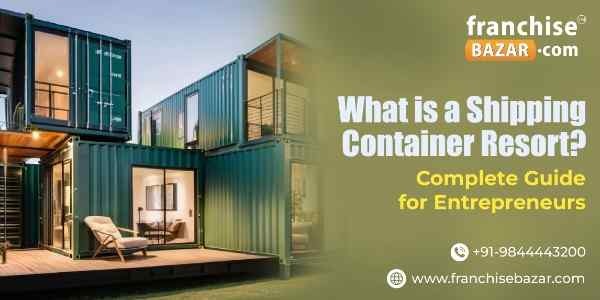
A shipping container resort is a type of lodging establishment where guest rooms, cottages, cafés, and communal areas are constructed from steel shipping containers that have been reused or custom-fabricated. Instead of laying bricks on site, you are, in effect, making hotel rooms in a factory and craning them into place. Building time is usually 3-6 months, compared with 12-18 months, and building costs are usually 30-40% less than for a traditional resort of the same size.
That's the part everyone leads with. What actually matters if you're considering this as a business is different: container construction changes how fast and how cheap you can open, but it does almost nothing to change whether people will actually come stay there. Keep that distinction in mind and this guide will save you a lot of money.
Here's what we'll cover: how these resorts are actually built, what they cost in India right now, the real trade-offs nobody puts in the brochure, and a practical path if you're deciding between building one yourself or going the franchise route.
What Exactly Is a Shipping Container Resort?
The resort's rooms (and sometimes the reception, café, and spa) are converted steel containers instead of brick and cement. Operators source these two ways:
- Shipping containers are defunct 20- or 40-foot ISO boxes that carried goods across oceans. They are split open, insulated and fitted-out for people to sleep in. They're cheaper on paper but come with baggage — literally. Old corrosion, warped floors, and sometimes chemical residue from whatever cargo they carried.
- Custom-fabricated container-form modules are newly built from scratch to look like shipping containers, but engineered for habitation from day one — better insulation, proper ventilation, no history to inspect. Most premium hospitality brands go this route now, and honestly, if you're building for guests rather than for a construction-site office, this is usually the smarter call even though it costs more upfront.
Each unit is basically a hotel room built off-site: bedroom, attached bath, small deck, air conditioning, wired and plumbed before it ever touches your land.
How Are Container Resorts Actually Built?
The process looks roughly like this:
- Design and layout — an architect works out unit count, spacing between rooms for privacy, and where the pool, restaurant, and reception go.
- Off-site fabrication — containers get cut, insulated, wired, and finished in a factory while your site is still being cleared.
- Site prep — foundation work (screw piles, concrete piers, or a simple plinth) happens in parallel, not after.
- Transport and placement — finished units get trucked in and lifted by crane, then hooked up to water and power.
- Finishing — decking, landscaping, signage. This is where the "resort" part actually starts looking like one, because raw steel units look more like a shipping yard than a getaway until you dress them up.
The overlap here is what makes container builds fast: fabrication and site work run at the same time instead of one waiting on the other.
Why Entrepreneurs Are Betting on This Model Right Now
A few things are converging.
Capital efficiency is the obvious one — you can open a boutique property for a fraction of what a concrete resort would cost, and you start earning while the traditional build next door is still pouring foundations. Modularity matters too: you can launch with 6 to 8 rooms, see how bookings go, and add units in phases instead of over-building on a hunch.
Generic hotels don't answer that query well. A container resort, with a clear sustainability story and a distinct look, does — and that's changing how these properties get found in the first place, not just how they get built.
And then there is the honest reason: they look good in a photo. In a market of near-identical concrete cottages, a steel-and-wood industrial-chic design is striking, and in hospitality, what appears on Instagram still drives a large percentage of bookings, whether we like to admit it or not.
What is the cost to invest in a Shipping Container Resort in India?
● Used 20-ft container shell (unconverted): ₹1–3 lakh
● New 20-ft container shell (unconverted): ₹1.6–2 lakh
● Converted 20-ft guest room (insulation, bathroom, electrical, finishing): ₹5–12 lakh
● Converted 40-ft guest room or suite: ₹10–20 lakh
● Foundation, crane placement, transportation and utilities hookup per unit: ₹1.5–5 lakh
A small property of 8 to 10 rooms (excluding land) would often be priced between ₹80 lakh to ₹2.5 crore depending on the quality of finish and facilities. Container resort concepts backed by franchisees with more complete service and branding have been placed at the level of ₹2 to ₹5 crore with land and marketing support included.
One thing worth flagging: quoted container prices are almost always ex-factory and exclude GST, site leveling, water and drainage connections, and the electrical service point. Suppliers won't volunteer this. Ask them to itemize it before you compare two quotes side by side, because the "cheaper" quote often just hides more costs downstream.
📈Is It Actually a Good Investment, or Just a Good Photo?
It can be a good investment. It's also not automatically one just because you used containers.
The construction method lowers your capital outlay and your time-to-open. It does nothing for the actual hard part of running a resort, which is filling rooms consistently and pricing them right. The properties that work tend to share a few traits: they're in locations that already pull weekend or leisure traffic (hill stations, coastlines, wine country, anything within a comfortable drive of a city), the land is leased or already owned rather than freshly purchased at market rate, and the concept leans into an actual experience — wellness, nature, adventure — rather than competing on room rate with the hotel down the road.
Where people get burned is treating "we built it out of containers" as the business plan itself. The steel box gets you attention once. It doesn't get you repeat bookings, an occupancy forecast, or a marketing budget. If you haven't worked out your average daily rate, your realistic occupancy across seasons, and where your bookings will actually come from — direct site, OTAs, referrals — before you order a single container, you're building a nice-looking problem.
Container Resort vs Traditional Resort
Build Time
- Container Resort: 3–6 months
- Traditional Resort: 12–24 months
Construction Cost
- Container Resort: 30–40% lower on average
- Traditional Resort: Higher, scales with labor and masonry
Scalability
- Container Resort: Add units in phases
- Traditional Resort: Usually built to full capacity upfront
Relocatability
- Container Resort: Often possible
- Traditional Resort: Not possible
Thermal Comfort
- Container Resort: Needs engineering to offset steel’s heat conduction
- Traditional Resort: Naturally better thermal mass
Guest Perception
- Container Resort: Novelty, industrial‑chic appeal
- Traditional Resort: Familiar, conventional
Financing
- Container Resort: Newer asset class, lenders more cautious
- Traditional Resort: Well understood by banks and NBFCs
Neither one wins outright. It ultimately depends on the type of stay you are attempting to sell, the ownership or leasing status of your land, and the amount of capital you hold.
Click here to know more about a Container Resort Franchise Opportunity in India
The Drawbacks Nobody Mentions in the Brochure
🔥Heat. Steel conducts heat far more than brick or concrete. An uninsulated container in an Indian summer is basically an oven, and getting this right takes real engineering — spray-foam or PUF insulation, ventilated air gaps, reflective roofing, sometimes a second roof layer. Cut corners here and you'll hear about it in every third review.
Corrosion. Most people don't realise seaside air and humidity erode steel faster. Marine-grade coatings and maintenance are required for coastal construction.
Perception. Some guests still hear "container" and think "temporary" or "budget," fairly or not. Your design and photography have to work harder to justify a premium rate than they would for a conventional boutique property.
Regulatory approvals. This one is a surprise to many. In most Indian states, portability does not absolve you from complying with land-use, fire-safety or building-approval standards. In general, container resorts are regulated to the same standard as any permanent structure, so “just move it” is not a way to avoid municipal permissions. Always check this before signing a deal, not after.
Financing. Several lenders and NBFCs are more careful financing against container hospitality than conventional real estate because it's a new asset class.
Should You Build It Yourself or Invest in a Franchise?
Three real paths here.
DIY build. You hire the architect, pick the fabricator, manage approvals and operations yourself. Full control, full upside, but you're also carrying all the execution risk and learning container engineering, hospitality operations, and brand-building all at once.
Franchise or branded partnership. You invest in an established container resort brand that hands you design templates, vetted fabrication sourcing, and marketing support, in exchange for franchise fees and often an ongoing royalty. Slower to break even because of that fee structure, but it removes a lot of the guesswork that sinks first-timers.
Managed or joint-venture model. You bring the land, an operating partner brings the design and hospitality know-how, and profit gets split. Works well when you have the asset but not the operating experience.
If this is your first hospitality venture, a franchise or managed model is worth serious consideration. Learning container fabrication, guest experience design, and demand generation simultaneously is a lot to absorb while also trying to hit revenue targets.
How to Actually Get Started
- Validate the location before anything else. Look at footfall, seasonality, what competing stays are charging, within a realistic drive radius. This step gets skipped more than any other.
- Lock down land — owned or leased — and confirm its land-use classification with local authorities.
- Get quotes from at least 2–3 fabricators. Not only the price per unit, but also the insulation's features and guarantee terms should be compared.
- Get plans approved. Fire-safety NOC, municipal or panchayat approval, and for larger properties, tourism department registration and environmental clearance.
- Run utilities and foundation work alongside fabrication so you're not waiting on one to finish the other.
- 💰Budget for the costs that don't show up in a container quote — transport, crane placement, utility hookups, landscaping, and working capital for the first 6 to 12 months.
- Build your distribution plan before you open, not after. Decide your OTA mix, get a direct-booking site live, and line up local partnerships. A striking design only helps bookings if people actually see it.

FAQs
Are shipping container resorts actually profitable in India?
They can be, but the construction method isn't what drives profitability. Location, pricing discipline, and occupancy management do the heavy lifting — a container resort in the wrong location will lose money just as fast as a concrete one would.
Do container homes get hot in summer?
Yes, if they're not insulated properly. Steel conducts heat much faster than brick or concrete. Spray-foam insulation, ventilated air gaps, and reflective roofing bring interiors down to livable, comfortable levels — but this needs to be engineered in from the start, not patched in later.
Is building with containers actually cheaper than bricks?
Yes, generally by about 30-40%, and largely from shorter build durations and fewer on-site labour and wastage. If you’re using premium reused containers or hefty custom fabrication, that gap narrows, so seek real bids instead of thinking the savings are automatic.
What licenses and permits are required to build a container resort in India?
It varies from state to state, but you will likely need permission for land use or zoning, building permission from the city or village, a fire safety NOC, and for bigger properties, registration with the tourism department and environmental clearance Container structures generally face the same regulatory bar as permanent buildings — don't assume otherwise.
Is it a good idea for an aspiring entrepreneur to franchise?
Often, yes. It trades some margin (franchise fees, royalties) for a proven design, vetted fabrication partners, and marketing support — which matters a lot if you're new to hospitality and don't want to be learning three businesses at once.
What's the actual difference between a container home and a container resort?
A container home is a private residence for one household. A container resort is a commercial hospitality operation with multiple guest units, shared amenities, staffing, and its own set of licensing requirements. Different scale, different rules entirely.
The Bottom Line
Container construction gets you to opening day faster and for less money. That’s real, and it’s worth something. But it doesn't take away from the work of finding a place that people want to visit, setting reasonable prices for rooms, and advertising your business to the right travelers. Treat the containers as your construction method, not your business strategy, and the math tends to work out a lot better.
Looking into container resort franchise opportunities? Compare vetted container resort franchise listings on Franchisebazar
#ResortFranchiseIndia #HospitalityInvestmentIndia #FranchiseOpportunitiesIndia #ContainerResortBusiness #EcoStayIndia #ResortFranchiseIndia #FranchiseBusinessIndia #HospitalityFranchiseOpportunities #FranchiseExpansionIndia #ContainerResortFranchise
Disclaimer: The brands mentioned in this blog are the recommendations provided by the author. FranchiseBAZAR does not claim to work with these brands / represent them / or are associated with them in any manner. Investors and prospective franchisees are to do their own due diligence before investing in any franchise business at their own risk and discretion. FranchiseBAZAR or its Directors disclaim any liability or risks arising out of any transactions that may take place due to the information provided in this blog.
Recent Blogs
Written By Resham Daswani
By the Franchisebazar...

Written By: Resham Daswani
Indian eco-resort...

Written By: Bandana Gupta
India’s...

Written By: Gouri Ghosh
You may be surprised...

Why Should I Register?
You are seeking to access information which is provided only to registered members. It takes less than a minute to register and access information on FRANCHISEBAZAR.