
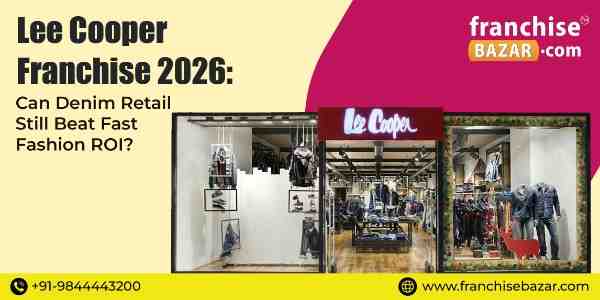
Lee Cooper Franchise 2026: Can Denim Retail Still Beat Fast Fashion ROI?
Written By: Gouri Ghosh
By 2026, one thing you may have probably noticed: competition is everywhere. New brands are opening stores, fast-fashion chains, and online-first labels at a high-speed rate. Choosing the right franchise is not easy; a wrong decision might be expensive. Today, ROI is more important than brand hype. A well-known name alone cannot guarantee profits. The matter is ' how stable the business model is, how fast you can recover your investment, and at what risk you carry in inventory'. This is where most franchise buyers begin by comparing denim retail and fast fashion. In this blog, you will learn how the two models actually work, which one provides safer returns, and whether a Lee Cooper franchise makes sense to you in 2026. If you are serious about buying a franchise and want clarity before investment, then this blog is for you.
Understanding the Two Business Models
Before making brand comparisons, you need to familiarize yourself with their business models. Many franchise buyers skip this step and regret it later
What Denim Retail Really Means for You as a Franchise Owner
Denim retail is an industry primarily concerned with dealing in denim products such as jeans, jackets, and casual wear.
- It's about necessities, not trends that change overnight
- You are dealing in products that are consumed by your customers throughout the year
- Denim franchise investment, such as in the Lee Cooper franchise, provides an element of stability.
What this means for you:
- The products have a longer life
- The inventory does not get obsolete quickly
- Customers buy on fit, not impulse.
- You will have returning customers
- Less Pressure to Discount
- Increased sales predictability
This indicates why the retailing of denim is still so popular among serious franchise buyers in the year 2026.
Denim Retail: Growth & Trends
|
Category |
Key Metric |
Data |
|
Global Denim Market Size |
Current Market Value (2024–25) |
USD 23–24 billion |
|
|
Market Forecast (2033) |
Expected to reach USD 33.6 billion |
|
|
CAGR |
Approx. 4.3% growth rate |
|
Global Denim Jeans Segment |
Market Size (2025) |
Approx. USD 75–80 billion |
|
|
Market Forecast (2035) |
Expected to exceed USD 110 billion |
|
|
CAGR Range |
3%–5.8% projected growth |
|
India Denim Market Growth |
Market Size Forecast (2026) |
Approx. USD 9.15 billion |
|
|
Annual Growth Rate |
8%–9% CAGR |
How Fast Fashion Franchises Operate
Fast fashion is a business model based on rapidly creating the latest fashion trends at affordable price points.
- New styles are quick to enter and quick to leave
- It is short-term interests and needs rather than long-term necessities of customers.
When you own a fast fashion franchise business, you would commonly deal with:
- Very Short Product Life Cycles
- Constant Inflow of New Inventory
- High dependence on discounts for the clearance of inventory
What it means to you as an Investor:
- People might be visiting your shop regularly
- But high footfall does not always mean high profits
Margins are often thin
A wrong trend choice can leave you stuck with dead stock
Fast Fashion Industry:
|
Category |
Key Metric / Insight |
Data & Statistics |
|
India Fast Fashion Growth |
Growth in FY24 |
30–40% growth |
|
|
Growth vs Overall Fashion Market |
Overall fashion 6% growth (FY24) |
|
|
India Market Forecast (2031) |
Expected to reach USD 50 billion |
|
Global Fast Fashion Market Outlook |
Market Size (Historic Baseline) |
USD 91 billion |
|
|
Forecast Market Size (2026) |
USD 133 billion |
|
|
Projected CAGR |
7.7% |
How Consumer Buying Patterns Are Changing in 2026
Customer habits are changing day by day, and as a franchise owner, you will have to understand them. You need to know how people shop nowadays.
Here's what you need to know:
- Customers are buying more for value, not just following trends.
- They want good-quality products that last for several years.
- Fit and comfort are more important than brand names.
- After all, people prefer brands that they can actually trust.
- Shoppers are thinking before buying, not on impulse.
- This works because denim is a wardrobe-friendly product.
- Customers look forward to products with enduring style.
- Some customers shop in both stores and online.
By knowing such patterns, you are able to select a franchise like Lee's. Cooper that meets customer demand and gives you stable sales and loyal customers.
Lee Cooper as a Denim Brand: Brand Power and Marketplace
Lee Cooper has more than 100 years of history and is widely established across the world, along with India.
Why this matters to you as a franchise owner:
- Customers are already familiar with the brand
- You do not have to shell out a lot of money just to create awareness
- Trusted brands bring repeat customers
In India, the Lee Cooper Franchise in India primarily appeals to:
- Young working professionals
- College-going youth
- People are seeking value for their money and branded goods.
Lee Cooper is also not exclusive to jeans, which is great for your business.
The product portfolio comprises:
- T-shirts
- Jackets
- Casual wear
- Accessories
This variety of products helps you to reduce, because you are not dependent on just one product category.
Lee Cooper Brand: History & Market Position
|
Category |
Key Insight |
Details |
|
Brand Background |
Brand Origin |
Founded in London in 1908 |
|
|
Brand Type |
Heritage denim & lifestyle brand |
|
|
Business Model |
Operates globally via licensing & retail partnerships |
|
Global Market Presence |
Countries Served |
Presence in nearly 100 countries |
|
|
Global Retail Network |
Over 6,000 outlets worldwide |
|
India Market Presence |
Retail Footprint |
Hundreds of selling points including EBOs, SIS & MBOs |
|
|
City Coverage |
Strong presence across metros, Tier-2 & Tier-3 cities |
|
|
Demand Drivers |
Rising aspirational demand for global denim brands |
|
Brand Performance |
Sales Volume |
Approx. 1.5 million garments sold in Q1 2023 |
|
|
Growth Rate |
Approx. 28% YoY growth in the period reported |
|
|
Brand Positioning |
Mid-premium, aspirational denim brand |
Investment Structure of a Lee Cooper Franchise in 2026
Let's break down the investment so that you know where you stand.
- The Lee Cooper investment cost in India: usually ₹50 lakh, depending on store size and location
- The sizes of retail outlets vary from 800-1500 sq. ft., preferably in shopping malls and busy streets.
For you as a franchise owner:
- The company operates on an inventory model
- You will require the presence of staff
- Operations are very simple, with the support of brands for merchandise and inventory.
Compared to fast fashion brands, the Lee franchise cost sits in a mid-investment, mid-risk zone, making it suitable for many new franchise buyers.
Lee Cooper Franchise profit Details
|
Metric |
Detail / Estimate |
Notes |
|
Total Investment |
₹50 L |
|
|
Franchise Fee |
₹5 L – ₹10 L |
|
|
Store Size Required |
800 – 1500 sq. ft. |
Ideal for high-footfall malls and high streets |
|
Royalty / Revenue Share |
10 % – 15 % |
|
|
Break-Even / ROI Time |
18 – 36 months |
ROI Breakdown: Denim Retailers vs Fast Fashion Outlets
This is the most relevant piece for you, an individual investor. Let’s keep it extremely simplified.
1. Revenue Stability
Denim retail
- Jeans and basic apparel are sold every month
- The sales are steady and predictable
- Your fashion doesn't depend on trends
Fashion fast
- Sales vary seasonally.
- One season could fare well, while another could falter
- You rely very much on trends
2. Margins & Discounts
With denim retail:
- More items are sold at full price
- Reduced requirement for discounts
- Improved management of profits
With fast fashion:
- Regular discounts are required
- Clearance sales are prevalent
- Profits decrease because of markdowns
3. Inventory Risk
Denim inventory:
- Can be sold over many months
- Can be carried forward to the next season
- Lower risk of dead stock
Fast fashion inventory:
- Becomes outdated very fast
- Unsold stock turns into dead stock
Denim vs Fast Fashion Franchise ROI Comparison
|
Metric |
Denim Retail |
Fast Fashion Franchise |
|
Typical Initial Investment |
₹50 – ₹1.2 Cr |
|
|
Revenue per Month (Example) |
₹8 – ₹20 L Estimate |
₹7 – ₹25 L Estimate |
|
Gross Profit Margin |
45–60% |
35–55% Varies with discounting |
|
Net Profit Margin |
10–22% |
8–18% |
|
Break-Even Time |
18–24 months |
Location Strategy: Where Denim Retail Outperforms Fast Fashion
Fast fashion is most successful in:
Large Metro Malls Very high footfall areas
The denim retail market, especially the Lee Cooper franchise in 2026, is strong in:
High streets Lifestyle malls
If you are investing outside a top metro, denim retail often delivers better ROI stability.
Who Should Consider a Lee Cooper Franchise in 2026?
A Lee Cooper franchise is best suited for:
- First-time Franchise Investors
- People are trying to open their own retail businesses
- Investors Looking for Long-Term Brand Value
- Multi-unit operators in search of stability
Risks for Lee Cooper Franchise
Every franchise faces some risks. Risks you may want to consider:
- Location risk: If foot traffic is low, sales may be affected.
- Inventory management: Too many orders can hold up your cash.
- Market competition: Many fashion brands are holding the market to attract consumer attention.
- Operational Discipline: Failure in brand standards can affect performance.
solutions for you:
- Select a location like a high-footfall shopping mall or high street location
- Reorder based on demand and not on guesses
- Focus on core denim products that sell year-round
- Follow brand SOPs and display guidelines strictly
Support You Get from Lee Cooper in 2026
Here’s what the brand has to offer:
- They advise on the design of the store layout so that your outlets appear upmarket and in line with the overall branding
- They train you and your staff, and you all know products, pricing, and how to treat your customer base
- They aid in merchandising. They teach you how to merchandise products for better sales.
- They help with inventory planning, so that you order the right items and do not lock up funds.
- They come with easy-to-use operating systems. This makes carrying out operations in the stores easier for you.
This type of assistance makes it easier to manage the business, especially when you’re just starting as a fashion retailer or purchasing your own franchise.
Action Checklist for Prospective Franchise Buyers
Before you move forward:
- Ask specific questions regarding ROI and support
- Comprehend total investment and working capital
- Carry out a location feasibility study
- Plan to break even in 18-24 months
Conclusion
If looking at fashion retail, denim retail still makes strong sense in 2026. Denim is not a trendy product. People buy jeans every year, in every season. Fast fashion can look attractive, driven by fast trends and high footfall. But it also means higher risk, frequent discounts, and uneven sales. And one weak season can delay your returns and add pressure to margins. Denim retail is, however, far more predictable, less so with a powerful brand such as Lee Cooper. Demand remains consistent, products last longer, inventory is easier to manage, and returns are easier to predict.
Owning a Lee Cooper franchise in 2026 isn't about following the buzz. It's about creating a solid, stable business over the long term with a dependable brand. If you're seeking balanced risk, clear systems, and dependable sales, denim retail can still outperform fast fashion on ROI for many investors.
Frequently Asked Questions (FAQs)
- Is the Lee Cooper franchise a sound investment in the year 2026?
Yes, Denim is an all-seasons product, and Lee Cooper happens to be an established brand. Of course, there is stability here.
- How much is the Lee Cooper Franchise Cost in India?
The franchise cost for Lee Cooper in India generally ranges from ₹50 lakh depending on the size and location of the store.
- How long will it take to reach break-even?
In most cases, lee Cooper franchisees work towards having a break-even in 18 to 24 months if the store is managed properly.
- Is denim retail safer than fast fashion?
yes. Denim has a longer shelf life, lower discount pressure, and more predictable demand compared to fast fashion.
- Is it necessary to have retail experience to open a Lee Cooper franchise business?
No. You do not. There is no requirement to have fashion retail experience. The brand will supply training and the guidance necessary to run the store.
Disclaimer: The brands mentioned in this blog are the recommendations provided by the author. FranchiseBAZAR does not claim to work with these brands / represent them / or are associated with them in any manner. Investors and prospective franchisees are to do their own due diligence before investing in any franchise business at their own risk and discretion. FranchiseBAZAR or its Directors disclaim any liability or risks arising out of any transactions that may take place due to the information provided in this blog.
Recent Blogs

Written By: Gouri Ghosh
By...

Written By: Gouri Ghosh
By the Franchisebazar...


Written By: Bandana Gupta
By the Franchisebazar...

Why Should I Register?
You are seeking to access information which is provided only to registered members. It takes less than a minute to register and access information on FRANCHISEBAZAR.