
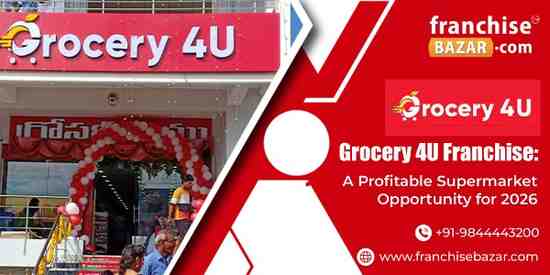
Grocery 4U Franchise: A Profitable Supermarket Opportunity for 2026
Written By: Khushboo Verma
In 2026, when investors are increasingly cautious about volatile demand, rising rentals, and unpredictable consumer sentiment, neighbourhood supermarkets are regaining attention for good reasons. The grocery 4u supermarket franchise fits into this shift by focusing on daily consumption, predictable footfall, and operational discipline rather than trend-driven retail.
Profitability in retail rarely comes from excitement. It comes from repetition.
The businesses that survive and scale are not the ones customers admire but the ones they depend on without thinking. Grocery sits at the center of that reality.
This is not a story about disruption or rapid scaling. Rather, it is about a category that works quietly, month after month, because households depend on it.
Why Grocery Remains One of the Most Defensive Retail Segments
Unlike discretionary retail, grocery spending does not pause when confidence weakens.
Families may delay fashion purchases, electronics upgrades, or dining out. However, essentials continue to move every single week.
Key Market Facts (December 2025):
- Traditional brick-and-mortar stores account for 97% of India's grocery sales
- Over 75% of consumer goods sales happen through kirana stores and organized retail outlets
- Online grocery accounts for only 3% despite quick commerce growth
- Offline dominance remains strong due to consumer preference for fresh produce
What is changing is where that spending goes within the offline segment. Consumers are steadily shifting away from fragmented kirana shopping toward organised neighbourhood supermarkets.
Why the shift?
- Better hygiene standards
- Transparent pricing
- Wider product assortments
- Reliable stock availability
The grocery 4u supermarket franchise is positioned squarely within this transition. It does not attempt to replace kiranas entirely, nor does it chase hypermarket-style scale. Rather, it focuses on becoming the dependable, nearby store for routine household purchases.
The Real Problem With Most Retail Franchises
Many retail franchises fail not because the brand is weak but because demand is optional.
Optional Demand Categories:
- Apparel and fashion
- Cafes and restaurants
- Salons and spas
- Specialty retail
When consumer confidence drops, revenue drops immediately while fixed costs remain unchanged.
Grocery operates differently. Demand is compulsory. Families cannot skip groceries for long, regardless of economic conditions.
Stability of Demand Impacts:
- Revenue predictability
- Inventory planning
- Cash flow management
- Ability to withstand slow periods
The grocery 4u supermarket franchise benefits from this defensive demand profile. Consequently, grocery continues to attract long-term operators rather than short-term speculators.
Understanding India's Retail Transformation in 2025
India's retail market reached approximately USD 1,060 billion in 2025 and is projected to grow at 11.4% annually.
|
Metric |
2025 Data |
Growth Trend |
|
Total Retail Market Size |
USD 1,060 billion |
11.4% annual growth |
|
Organized Retail Share |
20-22% |
Up from 12% in 2020 |
|
Food & Grocery Contribution |
55-65% of total retail |
Largest segment |
|
Grocery Market Growth (2025-2029) |
USD 352.8 billion expansion |
8.5% CAGR |
|
Offline Market Dominance |
97% of grocery sales |
Stable and growing |
These numbers demonstrate that despite the growth of online grocery, offline supermarkets remain the backbone of India's grocery retail landscape.
This creates a stable foundation for the grocery 4u supermarket franchise model.
What Grocery 4U Actually Offers as a Franchise
Product Categories:
- Staples (rice, atta, pulses, sugar, oils)
- Packaged FMCG products
- Fresh fruits and vegetables
- Dairy and frozen foods
- Household and personal care items
But the real offering is not the product range. Rather, it is the operating structure.
Operating Model:
- Stores designed around residential catchments
- Focus on nearby, stocked, and familiar shopping
- Habit-based footfall rather than promotion-driven traffic
Franchise Partner Benefits:
- Faster stabilization of daily sales
- More predictable basket sizes
- Lower dependency on discounts
- Higher repeat customer ratios
This operating logic sits at the core of the grocery 4u supermarket franchise model.
Understanding Supermarket Economics in Practical Terms
Grocery is often labeled a low-margin business, which is true in isolation. However, margin alone is not the right metric.
Volume consistency and inventory turnover determine profitability.
Typical Financial Performance:
|
Parameter |
Range |
Industry Benchmark |
|
Gross Margins |
12-18% |
Standard for supermarkets |
|
Net Margins |
2-8% |
After all expenses |
|
Inventory Turnover |
Multiple times/month |
Critical for profitability |
|
Break-Even Timeline |
12-18 months |
For well-managed stores |
Real Examples:
- Avenue Supermarts operates on lower margins but achieves profitability through high volume
- Trent Ltd achieves net profit margins of around 8.87% through operational efficiency
While these numbers may not sound dramatic, they are reliable. Over time, consistent turnover and controlled costs deliver steady cash flows.
The grocery 4u supermarket franchise provides structured backend support, reducing guesswork for franchise owners.
Inventory Management: Where Profit Is Won or Lost
In grocery retail, inventory is the business.
The Balance:
- Too much stock = blocked capital + increased spoilage
- Too little stock = broken customer trust + lost sales
Grocery 4U Support Systems:
- SKU rationalization guidance
- Category-wise margin planning
- Reorder frequency frameworks
- Centralized sourcing for essential categories
- Technology-enabled billing and stock tracking
These systems reduce operational friction and help maintain healthy inventory rotation.
Most supermarket failures can be traced back to inventory mismanagement, not lack of customers.
Location Strategy That Prioritizes Profitability
Unlike fashion or foodservice, grocery does not benefit from premium locations. Instead, it benefits from proximity and density.
Most Effective Locations:
- High-density residential neighbourhoods
- Mixed-use areas with daily pedestrian traffic
- Tier 2 cities and growing suburbs of metros
- Areas underserved by organised grocery
Why This Matters:
By avoiding mall-led or high-rent formats, Grocery 4U helps franchise partners maintain sensible rent-to-revenue ratios.
Industry data shows that Tier 2 and Tier 3 cities are witnessing rapid growth in organized retail. These markets offer better rent economics while still providing substantial customer density.
The grocery 4u supermarket franchise focuses on accessibility rather than visibility, which aligns better with real grocery buying behaviour.
Competition: Why Grocery Still Has Room to Grow
At first glance, the grocery appears overcrowded. Kirana stores, national chains, and online platforms all compete for the same wallet.
However, competition in grocery is not winner-takes-all.
How Customers Split Purchases:
|
Format |
Purchase Type |
Market Share |
|
Kirana Stores |
Urgent needs, small quantities |
75-78% |
|
Supermarkets |
Planned weekly shopping |
20-22% (organized) |
|
Online Platforms |
Convenience orders |
3% |
Customers split purchases across formats. Kiranas dominate urgent needs, online platforms serve convenience-driven orders, and supermarkets handle planned, weekly shopping.
Grocery 4U operates in this planned-purchase segment. It does not rely on instant delivery or impulse traffic. Instead, it relies on reliability, assortment, and familiarity.
This positioning allows organised supermarkets to coexist with both kiranas and online players rather than be eliminated by them.
Financial Viability and Break-Even Timeline
Understanding the financial structure helps potential franchisees make informed decisions.
Initial Investment Components:
- Store setup and fixtures
- Initial inventory
- Technology systems
- Working capital buffer
- Franchise fees
Typical Revenue Pattern:
|
Period |
Phase |
Focus |
|
Months 1-3 |
Stabilization |
Building customer base |
|
Months 4-8 |
Growth |
Expanding repeat customers |
|
Months 9-12 |
Break-even |
Approaching profitability |
|
Year 2+ |
Profitability |
Stable cash flows |
Most well-managed supermarket franchises achieve break-even within 12-18 months. Thereafter, consistent operations lead to stable monthly cash flows.
The key is maintaining discipline during the initial phase.
Technology Integration for Modern Operations
In 2025, successful grocery operations leverage technology effectively.
The Grocery 4U Franchise Incorporates:
- Point-of-sale systems with real-time tracking
- Digital payment integration (UPI, wallets, cards)
- Inventory management software
- Customer relationship management
- Vendor management platforms
Digital Payment Landscape (2025):
- UPI transactions crossed INR 18.68 billion in May 2025
- Smartphone penetration exceeds 880 million
- Digital payment adoption has become standard
Therefore, modern grocery operations must integrate these technologies seamlessly.
Risks Investors Should Evaluate Honestly
Grocery is stable, but it is not passive. Success depends on execution.
Key Risks to Consider:
- Poor inventory discipline leading to wastage
- Overstaffing or weak supervision
- Insufficient working capital buffers
- Overpaying for rental locations
- Intense local competition
A franchise system reduces risk through structure. However, it does not replace active involvement.
Investors should be prepared to engage closely, especially during the first year.
The grocery 4u supermarket franchise rewards operators who respect process and consistency.
Who Should Consider This Opportunity in 2026
Best Suited For:
- First-time entrepreneurs seeking a steady retail business
- Family-run enterprises transitioning from kirana or wholesale
- Investors focused on predictable monthly cash flows
- Operators targeting Tier 2 cities or metro residential zones
Not Ideal For:
- Investors chasing rapid exits
- Lifestyle branding enthusiasts
- Hands-off ownership seekers
Grocery requires daily attention and operational commitment.
The 2026 Outlook for Neighborhood Supermarkets
India's retail landscape in 2026 presents unique opportunities.
Growth Projections:
- Organized retail sector projected to capture over 35% of total retail market by 2030
- Market value expected to exceed USD 600 billion by 2030
- Smaller cities are becoming key drivers of retail expansion
- Lower real estate costs creating favorable unit economics
The grocery 4u supermarket franchise aligns perfectly with these market dynamics, offering a structured entry point into organized grocery retail.
Final Assessment
In an environment where many franchises rely on aspiration, novelty, or aggressive discounting, grocery succeeds on necessity.
That is its advantage.
What the Grocery 4U Franchise Offers:
- Structured entry into organised retail
- Defensible demand backed by household necessity
- Manageable investment levels
- Long-term business relevance
- Reliability over glamour
For 2026, when investors are prioritizing stability over speculation, neighbourhood supermarkets remain one of the most sensible retail bets in India.
The fundamentals are clear:
- Grocery demand is non-negotiable
- The market is growing steadily at 8.5% CAGR
- Organized retail is gaining share (20-22% and rising)
- Offline stores dominate with 97% market share
For operators willing to commit to daily execution, the grocery 4u supermarket franchise presents a viable path to building a sustainable retail business in India's evolving grocery landscape.
Grocery 4U aligns well with that opportunity, provided it is approached with realistic expectations and disciplined execution.
Disclaimer: The brands mentioned in this blog are the recommendations provided by the author. FranchiseBAZAR does not claim to work with these brands / represent them / or are associated with them in any manner. Investors and prospective franchisees are to do their own due diligence before investing in any franchise business at their own risk and discretion. FranchiseBAZAR or its Directors disclaim any liability or risks arising out of any transactions that may take place due to the information provided in this blog.
Recent Blogs

If you’re eyeing the best business ideas in India for 2027,...

Introduction
Kalyan Jewellers is...

Looking for the top footwear...

If you are searching for a Green Trends

33, Race Course Road,
Bangalore - 560001, India
Green Park Metro Station Gate:2,
New Delhi - 110049, India
Mumbai - 400009,
India
Frisco, Texas, 75035
USA
Why Should I Register?
You are seeking to access information which is provided only to registered members. It takes less than a minute to register and access information on FRANCHISEBAZAR.