
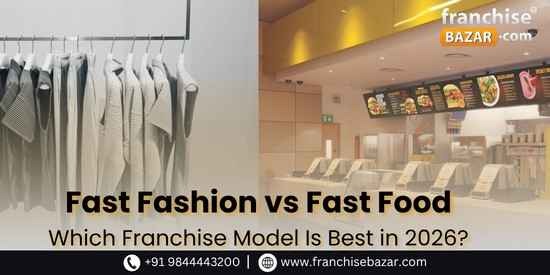
Fast Fashion vs Fast Food: Which Franchise Model Is Best in 2026?
Written By: Bandana Gupta
Starting a franchise business in 2026 is a way to get into the Indian business market. You will have a known brand name and people to help you. A lot of people like to start food franchises or fast fashion franchises.
These are popular because peoples lives are changing they have money to spend, and younger people want to buy more things.
Fast food franchises and fast fashion franchises are very different. Fast food is about serving people every day and getting them in and quickly. Fast fashion is about keeping up with what's popular, having new clothes for each season, and making the store look nice.
If you want to invest in a franchise in India, you should know the differences between fast food franchises and fast fashion franchises. This will help you pick the one for you based on how much money you have, how much risk you are willing to take, and what you want to achieve with your business in the long run.
Learn about the fast food franchise model.
The fast food franchise model is about getting a lot of customers, serving them quickly and having them come back every day to buy food from you again.
Some popular fast food franchises are McDonalds, Domino's Pizza, KFC, Wow! Momo and Jumboking. These are all examples of fast food franchise systems in India.
The fast food franchise model is really about food franchises, like these, where people go to eat and come back again and again.
Characteristics of Quick Service Restaurant Franchise
*High Turnover of Products
Since there is daily demand for products and the products themselves are perishable, there must be a very high turnover of goods every day.
*Loyalty and Repeat Visit
As Food is a basic need for every person, so there will always be order for food and snacks because people often prefer to eat from outside, as a result, there is increase in sales all year round.
*Simplified Operations
There are certain key factors related to operations in many QSR restaurants:
• The Supply Chain
• Vendor Partners
• Professional Employees
• Technology
• Food delivery through apps
This helps in developing systematic procedures.
*Small Investment
Another great feature of fast food joints is low investment.
Investments needed for each category:
• ₹2 to ₹5 Lakhs for food kiosk
• ₹10 to ₹25 Lakhs for standard QSR units
• Larger investment for a premium restaurant type
*Growth Potential
Fast food restaurants operate on:
• A profit margin of 15%-30%
• Simplified inventory management
• High cash flow owing to sales each day
Successful ventures break-even in 12-24 months
How the Fast Fashion Franchise Model Works
Through this franchise arrangement, fashion brands offer opportunities for entrepreneurs to operate clothing retail shops through their established brands. Instead of setting up new fashion brands, the entrepreneur enters into an agreement with the existing brand that has a reputation among consumers, an established marketing network, and pre-existing product lines.
In this case, the franchise is responsible for financing the opening and local operation of the clothing shop, while the brand is responsible for critical decisions such as product lines, prices, brand image, and presentation of the shop.
Due to the rapid nature of the fashion industry, trend forecasting and efficient management of the supply chain are crucial in this business model.
Understanding the Fast Fashion Franchise Model is really important.
The Fast Fashion Franchise Model is designed to bring the clothing trends to Fast Fashion customers as quickly as possible.
Fast Fashion brands continuously introduce collections to encourage people to visit the Fast Fashion stores again and again and make impulse purchases.
Some popular retail fashion brands like Zudio, Pantaloons, and Uniqlo follow systems that focus on moving inventory and affordable fashion for the Fast Fashion customers.
How the Fast Fashion Franchise Model Works
*Brand Recognition and Customer Trust
After buying a franchise, the big advantage is the use of brand name and customer recognition, which they get immediately and without spending a lot of money.
Franchise owners get to benefit from things like:
* Existing brand popularity
* marketing campaigns
* Customer loyalty
* Proven retail systems
This makes it less risky than starting their own clothing business from scratch.
*Fast Fashion Trends
Fast fashion brands are very good at knowing what people like.
They can make Fast Fashion clothes. Get these Fast Fashion clothes in stores very quickly sometimes it only takes a few weeks to get the Fast Fashion clothes in stores.
This means that franchise stores can sell things like:
* Trending styles
* collections
* Fashion influenced by celebrities
* Affordable everyday wear
When stores get new clothes in, often it keeps customers interested and makes them come back to the store more often.
*Inventory Management
Most of the time, people who buy a franchise do not make their clothes.
The main company makes the clothes. Sends them to the franchise stores.
This helps make sure that:
* The clothes are always of quality
* The branding looks the same everywhere
* The prices are the same everywhere
* Stores can get clothes quickly when they need them
Common Franchise Models in Fast Fashion
There are two main ways that fashion brands do franchises.
1. The FOFO Model (Franchise Owned, Franchise Operated)
Under the FOFO Model, the person who buys the franchise:
* Pays for the store to be set up
* Hires staff and runs the store day to day
* Buys clothes from the brand
* Makes money from selling the clothes
This way, the person who buys the franchise gets to make a lot of the decisions. They still have to abide by the brand's rules.
The second model is the FOCO Model, which means Franchise Owned, Company Operated.
In the FOCO Model:
* The person who buys the franchise pays for the store and the space
* The main company runs the store
* The main company hires staff. Buys the clothes
* The main company is in charge of the day to day business
This way is better, for people who want to invest in a business but do not want to do all the work themselves.
Key Features of Fast Fashion Franchises
Fashion franchises have seasonal product cycles. This means that the clothes in the store are only popular for a time. If the clothes do not sell, they can become outdated quickly.
The clothes in the store can last for a time, but the trends change so fast. This is different from food products. Food products can go bad after some time. Fast fashion franchises have to deal with trends that change every season.
Fast fashion franchises have a number of products to manage. They have to deal with sizes of clothes. They also have to manage colors and various designs. They even have collections. This makes managing the products in the store more complicated than managing food products.
For example, fashion stores manage:
• sizes of clothes
• Multiple colors of the same product
• Various designs of clothes
• Seasonal collections of clothes
The way the products are displayed in the store is also very important for fast fashion franchises. This is called merchandising. It plays a role in selling the products. The people who own the franchises often need to:
• Update the displays in the store frequently
• Create attractive store layouts to make people want to come in
• Add seasonal branding to the store to make it look more interesting
• Use marketing that focuses on the current trends
Fast fashion franchises usually need a lot of money to start. They need a store and a lot of products to sell.
The amount of money you need to invest in a fashion franchise can vary. For example:
• Small stores that sell different brands of clothes can cost between ₹20 Lakhs to ₹50 Lakhs
• Large stores that sell one brand of clothes can cost ₹1 Crore or more
Fast fashion franchises can make a lot of money, but they also come with some risks. The profits from selling the products can be between 30% to 50%.
However, the profits can be affected by things such as:
• Selling products at a discount
• Not being able to sell all the products
• Changes in what the customers want to buy
• High costs of renting the store
The franchise can take about 24 to 36 months to make profit.
Fast Food vs Fast Fashion: Major Differences
|
Feature |
Fast Food / QSR |
Fast Fashion Retail |
|
Consumer Demand |
Daily and frequent |
Seasonal and occasional |
|
Product Shelf Life |
Short and perishable |
Longer but trend-sensitive |
|
Initial Investment |
Lower to medium |
Medium to very high |
|
Inventory Risk |
Food spoilage |
Unsold seasonal stock |
|
Operations |
Kitchen and staff management |
Display and inventory management |
|
Profit Margins |
Lower margins, high volume |
Higher margins, inventory risk |
|
Break-even Period |
12–24 months |
24–36 months |
|
Best For |
Quick scaling and steady cash flow |
Long-term retail brand building |
Reasons Why Fast Food Franchises Operate More Efficiently in 2026
Fast food franchises continue to lead the Indian franchise industry due to some factors in 2026.
*Purchase as Part of Everyday Activities
Food is bought daily as compared to fashion items, which are purchased only sometimes. It leads to consistent profits every month.
*Easier To Expand
Expansion of QSR brands can be done easily through:
• Many units
• Cloud kitchens
• Delivery models
• Food Kiosks
* Improved Franchise Support Programs
Major food brands have support systems such as:
• Training Programs
• Procurement Programs
• Campaigns
• Tech Programs
• Delivery Program
It makes operations easy for the franchisees.
*Easier To Open
As compared to fashion, food businesses offer low startup investments in most cases. As a result, it becomes convenient for new entrepreneurs.
Difficulties for Fast Food Franchises
Along with the good growth prospects, fast food companies experience challenges like:
• Food Waste
• Employee Issues
• Hygiene Issues
• Issue of Rising Prices
• Delivery Charges
Nonetheless, consistent demand compensates for all the difficulties.
Challenges in Fast Fashion Franchises
The thing about fashion retail is that it has a lot of problems.
Fashion retail carries risks, such as
* Changing trends in Fast Fashion
* Stores in Fast Fashion have to rely much on heavy discounts
* Fast Fashion companies end up with a lot of inventory
* Fast Fashion businesses need a lot of money to run
* The cost of renting a store for Fast Fashion is very expensive
This makes Fast Fashion more suitable for investors who have a lot of money and know a lot about running stores in Fast Fashion.
FOCO Model: A Growing Alternative
The FOCO Model is a way of doing things. Some companies are now using the FOCO Model. This is what it looks like:
* The person who invests in the FOCO Model gives the company money and a place to work
* The company takes care of the FOCO Model every day
The FOCO Model is getting popular in the food business and in stores because it makes things easier for the people who invest in the FOCO Model.
You may also like to:
FOFO VS FOCO Franchise Model Explained
Which Franchise Model Do You Need?
Based on your financial and personal considerations, choose the appropriate franchise model.
Opt For Fast Food Franchise Business If:
• You need faster ROI
• You like stable income daily
• Your investment budget is lower
• You desire scalable operations
• You favor systems rather than retail skills
Opt For Fast Fashion Franchise Business If:
• You have retail skills
• You can invest a bigger sum of money
• You do not mind taking inventory risk
• You want to start a retail business for the long term
Conclusion
While fast fashion and fast food franchises can provide excellent growth opportunities in India in 2026, fast food franchises appear to be a more sensible choice for entrepreneurs as compared to fast fashion, as they benefit from recurring consumer demand, flexible investment options, support mechanisms, and higher ROI.
Profit margins in the case of fast fashion can be huge in premium stores, but the former business would require significantly larger capital investment, strong inventory management capabilities, and flexibility in adapting to market trends.
It is important to thoroughly examine all aspects before entering into any kind of franchise agreement, from franchise costs to local market conditions, operational expenses, and cash requirements.
Disclaimer: The brands mentioned in this blog are the recommendations provided by the author. FranchiseBAZAR does not claim to work with these brands / represent them / or are associated with them in any manner. Investors and prospective franchisees are to do their own due diligence before investing in any franchise business at their own risk and discretion. FranchiseBAZAR or its Directors disclaim any liability or risks arising out of any transactions that may take place due to the information provided in this blog.
Recent Blogs

Written By: Gouri Ghosh
The educational industry...
Written By: Bandana Gupta
The restaurant business...

Written By: Bandana Gupta
Introduction
The...
Written By: Bandana Gupta
The food and beverage...

Why Should I Register?
You are seeking to access information which is provided only to registered members. It takes less than a minute to register and access information on FRANCHISEBAZAR.